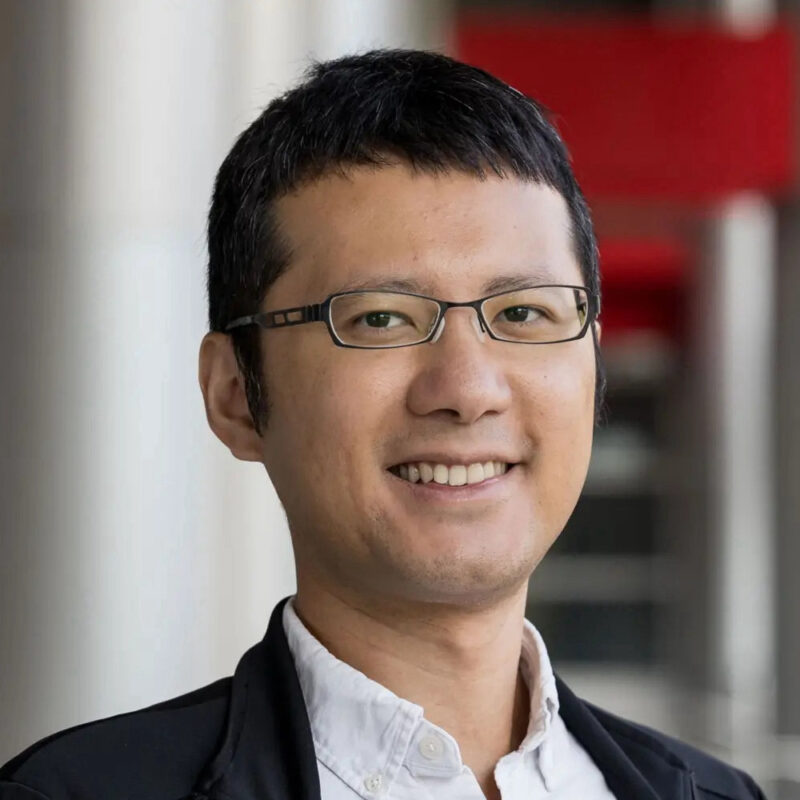
Tsung-Wei (TW) Huang
PhD, Electrical and Computer Engineering
Associate Professor, Department of Electrical & Computer Engineering, University of Wisconsin-Madison
3423 Engineering Hall
1415 Engineering Dr
Madison, WI
Tsung-Wei Huang is Making Parallel Computing Easy and Accessible with Open Source
Parallel computing powers many of today’s most demanding applications, from artificial intelligence to scientific simulations. Yet writing efficient parallel programs remains one of the most challenging tasks in modern software development. Tsung-Wei (TW) Huang, an Associate Professor in the Electrical and Computer Engineering Department at the University of Wisconsin–Madison, is working to change that. Through open source software, Huang aims to make parallel computing easier and more accessible to developers around the world.
One of Huang’s most influential contributions is Taskflow (https://taskflow.github.io/), an open-source task-parallel programming system designed to simplify how programs execute multiple tasks simultaneously. Modern software often consists of many tasks that must run in parallel while respecting dependencies between them. Managing this coordination efficiently can be difficult, especially on systems with many processor cores.
“Think about coordinating multiple workers so they can solve a problem together without conflict,” Huang explains. “Some tasks can run at the same time, while others depend on previous work finishing first…”
Taskflow is a system designed to optimize that process. It coordinates the computer’s work across multiple chips. The delegation of tasks across chips allows computers to run tasks simultaneously, speeding up the computing process by a fair margin.
“With Taskflow, you only need to specify a task and its dependencies,” Huang says. “Taskflow handles the parallelization for you.”
Huang’s work with Taskflow began long before the project’s conception. While working on his PhD at the University of Illinois Urbana-Champaign, Huang created a program that could report on the speed of a computer’s operations.
“I began on a different open-source project, OpenTimer (https://github.com/OpenTimer/OpenTimer). We built it to analyze circuit design.” Huang recalls. While working on that project, Huang realized that the techniques used to accelerate circuit analysis could also be applied more broadly to other computational workloads.
“I realized that the technology we built to accelerate circuit design automation could be useful beyond that domain,” he says. “That idea eventually led to Taskflow.”
Since its release, Taskflow has grown into a widely used open-source project with contributors and users around the world. The system continues to evolve alongside modern C++ and the rapidly changing landscape of high-performance computing.
For Huang, one of the most rewarding aspects of open-source development is seeing how people adapt the software for applications he never originally imagined.
“There was a company using Taskflow to run a computer vision workload inside a drone,” Huang says. “We didn’t design Taskflow with drones in mind. I didn’t even consider that possibility until they reached out to the Taskflow community asking for help. That’s one of the most exciting parts—seeing how people use the project in their own applications.”
Open-source collaboration also plays an important role in improving the software itself. Rather than trying to build a perfect system from the beginning, Huang sees community feedback as an essential part of developing reliable infrastructure.
“Nobody can build a perfect system,” he says. “You may have bugs or issues you don’t know about. But when people use your project, they can help identify those problems and work together to find solutions.”
Recently, the Taskflow community at the University of Wisconsin–Madison expanded further. In Spring 2026, the project welcomed a new intern through the university’s Open Source Program Office (OSPO). The student quickly became an active contributor to the project.
“She just began working on the project, and the experience so far has been very nice,” Huang says. “The student is amazing. It’s great to see her apply her knowledge of C++ to high-performance computing. And this is a real system—she’s contributing to a project that people outside the university are actually using.”
The Taskflow project benefits from contributions and feedback from developers across the globe. Huang believes that the transparency of open-source development helps make collaboration straightforward and productive.
“We don’t have many communication challenges,” he says. “If people have questions, they simply ask them on our GitHub repository. Because everything is open and transparent, we continuously receive feedback from users. That allows us to improve the system based on what people actually need.”
Huang has also seen a significant shift in attitudes toward open source during his career. When he was a PhD student, releasing research software openly was far less common. Today, open source has become a fundamental part of the modern software ecosystem.
“In the past, if you told people you wanted to make your project open source, they might have thought you were crazy,” Huang says. “But now the benefits are clear. Major companies and government projects are supporting open-source initiatives. This shift is helping people collaborate across different disciplines.”
For Huang, that collaborative spirit is one of the most powerful aspects of open source. By sharing tools and ideas openly, developers and researchers can collectively build technologies that benefit a much wider community. He encourages students and developers who are curious about parallel computing to explore open-source projects and learn by participating.
“Download an open-source project and try using it,” Huang says. “Learn how the repository works and how the community maintains the project. Almost every software today relies on open-source projects. It has become a central part of the modern software landscape, and there are many opportunities to get involved.”