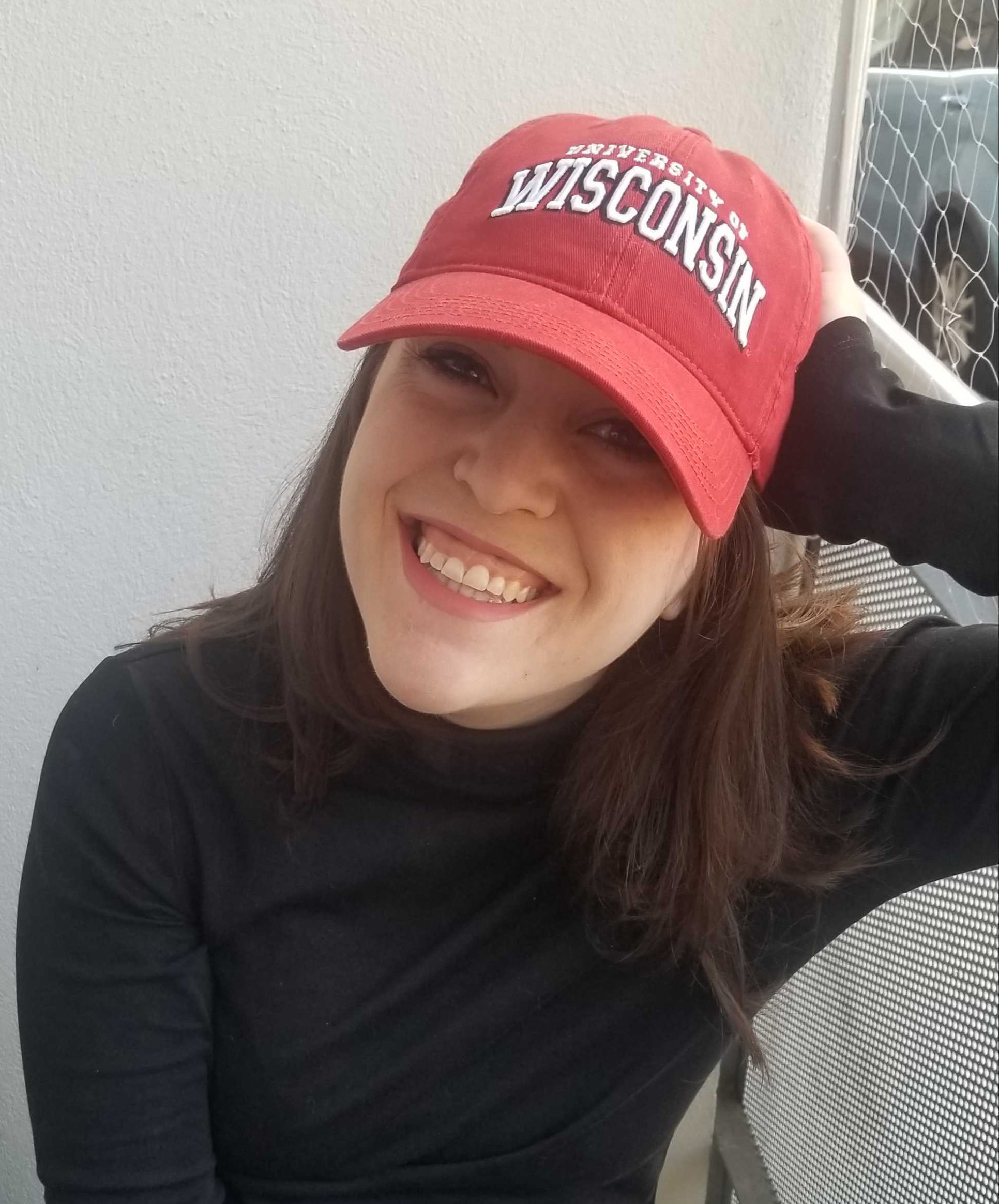
Rose Cersonsky
PhD, Macromolecular Science and Engineering
Assistant Professor, Department of Chemical and Biological Engineering, University of Wisconsin-Madison
Engineering Hall
1415 Engineering Dr
Madison, WI
Building The Future: Rose Cersonsky and the Use of Open Source for Atomic Modeling
From building a rock wall in her basement to building an open source project that models the interactions of particles at a subatomic level, Rose Cersonsky loves tackling life’s puzzles. Today, she satisfies her academic curiosity through the utilization of open source programs in her research. She has begun to simulate the puzzling interactions between models with machine learning algorithms, a challenge she faces with confidence and enthusiasm.
A Mike and Virginia Conway Assistant Professor of Chemical and Biological Engineering, Cersonsky balances a life of teaching, research, and administrative work. After initially going into the study of Civil Engineering, Cersonsky discovered that her true passion was the study of materials- a passion that guided her towards working in the realm of molecular simulation.
“Molecular simulation is a way of taking computers and mimicking physics, mimicking statistics, and seeing how a system evolves with time or evolves with some change,” Cersonsky explained, “Machine learning modeling, then, is trying to take some sort of data points and make some analyses of those data points to understand what’s happening.”
With open source software, Cersonsky has been able to combine both of these approaches to analyze created data. The main project worked on by her lab is called scikit-matter, a project built in collaboration with the open source scikit-learn ecosystem. The project builds rules for chemical based machine learning problems.
Using open source, Rose Cersonsky has been able to build upon previous work. Due to this, her labs have been able to keep their projects aligned with any research needs they come across.
About her recent research she said, “We’ve been doing it with classification models lately, seeing a classification model and looking at how, essentially, the model is weighting the directions in that high dimensional space. Through our methods, we can see what other data points the model considers to be close or far. We can then use that information to make some sort of analysis about what is changing within the model.”
With her use of open source programs in her research, it is not a surprise that Cersonsky is an avid supporter of the practice. Open source research, she says, will be necessary for progress in most academic fields.
“I always think that open source software is the correct way to do science, particularly academic science,” She said, “Just being able to circulate that information and give people a starting point- It is the ethical, pedagogical, and academic way to do science.”
To Cersonsky, open source helps researchers make the projects they actually want to make. When someone has already built a basis for it, it is easier for a researcher to tailor it to their own research process. With open source, a researcher does not have to start from square one- and they can begin solving the puzzle they want to solve at a faster rate.
A large benefit of open source research is its general accessibility. People without previous coding experience oftentimes view computer-based research as a barrier. With open source, those barriers can be removed as collaborators provide each other with steps in the development process.
“I think that science is best when all who are interested in studying it or pursuing it have fewer barriers to doing so,” Cersonsky said about open source in research, “If we leave software as passed-around Fortran and C++ codes amongst one research group,and only that research group ever gets to use that methodology, then we are not embracing being the best versions of science.”
To increase the accessibility of her own projects, Cersonsky ensures proper documentation in her lab. As soon as a student is accepted, she teaches them how to document their work in Github. Many of the students she works with have little experience in the field of computer science. Helping them learn these systems can be fundamental for their professional development.
Cersonsky also works with the Open Source Program Office’s internship program to support students who want to use their knowledge of computer science to benefit the world of research. A major barrier to the spread of open source has been its lack of funding. The internship program can give financial support to interns, allowing them to dedicate more time to the research they perform. For Cersonsky, funding these projects has been their main challenge- but the community on campus has provided incredible support to her lab and many others.
Rose Cersonsky believes that open source is the future of scientific research. By investing in it, she said, our world invests in progress, sustainability, and the spread of knowledge.
“When we don’t use open source, we are halting the future.” Cersonsky said, “We are raising ourselves up when we should be focusing on raising science up.”