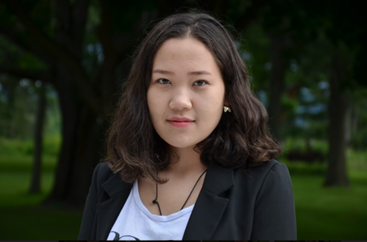
Mandy Alimaa
MS, Computer Science
Full Stack Developer
Closing a Door to Open Another: How Mandy Alimaa Kickstarted Her Open Source Career with an OSPO Internship
With an undergraduate degree in business, Mandy Alimaa, a recently graduated masters student at the University of Wisconsin-Madison, made quite the pivot when she began pursuing a graduate degree in computer science. After taking a class in the field during her undergraduate degree, she found that she loved computer science- but was already too far into her degree path to make the switch.
“I took a CS class as an elective course in my undergrad. I really liked it, and the professor said I had a knack for it too. At the time it was too late to switch my major…I decided then that I was gonna go get the masters.”
Mandy was not lacking in coding experience- she worked as a full stack developer before she applied for her masters program. The company she worked for was entirely closed source. Her experiences there, while not necessarily negative, made her curious about open source programming.
“In closed source programming, you’re treated like a work machine. You almost feel invisible.”
Alimaa had never heard about the OSPO before arriving at UW. When she received an email from the Open Source Program Office, informing students about their new internship program, she was pleasantly surprised. It was the perfect opportunity for her to finally get involved.
“I got an e-mail from the OSPO advertising the program. I wanted to do open source contributions, but I really never really know how to…I scanned the questions list and applied for the one most relevant to my interests.”
Alimaa only applied for one internship program- OpenLambda, an FaaS coded in Go.
“It was my only pick. It was the internship closest to distributed systems. It’s aligned really well with my interests, and I only wanted that one.”
Like many students first entering the OSPO program, Alimaa had little experience in the world of open source. She began to worry whether her contributions would be good enough.
“At first I was scared. Open source means everybody else can see your code… I began to wonder, what if I can’t do it? I feel like everybody probably has that doubt before they start something,” Mandy explained.
Thankfully, the OSPO internship program paired her directly with an experienced mentor. Tyler Caraza-Harter, the mentor for and creator of OpenLambda, did his best to make the project accessible. Alimaa claims it was his support that made her experience worthwhile.
“Having a mentor, Tyler, made it really easy. He explained things really well. If I had doubts, I could just e-mail him and meet with him. I don’t think I could have done it without Tyler.”
As she began to produce more code, Alimaa began to love the world of open source. Her contributions were recognizable, her work was fun, and the connections she made were indispensable. With open source, she herself was worthwhile, a feeling she failed to receive during her time at her previous, closed source company.
“I would say I would prefer open source, for sure. I’m being seen by the community.”
The OSPO internship program was the perfect stepping stone for Alimaa. She leveraged the experience to find another internship at an open source startup. When she graduates, she will begin working there full time.
“I now work at Columnar Technologies. I am building ADBC drivers and maintaining existing ADBC drivers. The work really interests me, and is challenging in a way that I really enjoy,” she said. Connecting it to her work at the OSPO, Alimaa said, “If somebody’s looking for entry to the open source community, they should 100% do this internship. It leads to many other opportunities.”
Alimaa says the best part of the internship was how it built her portfolio. Because the work she did was open source, she can link it anywhere. She can directly show prospective employers the work she completed.
“Open source contributions lead to a lot of connections. People recognize you, recognize your code…the contributions will always be associated with your name. If you’re looking for another job, a hirer can literally open your profile and see exactly what your code looks like.”
Students can get involved in open source whenever they would like. The online community is always looking for more help, and interested students are usually just an email away from beginning their own open source journey.
“There are a lot of good discussion boards in the open source community where you can just be like, ‘hey, I am looking to contribute, please let me know how I can’. Someone will probably respond to you. So just get started.”
Alimaa insists that the OSPO internship helped her in the long term. With support from her mentor, support from her fellow interns, and support from the OSPO, she has been able to build a career doing what she loves.
“Open source is the best way to build actual skills that affect real life. Beyond that, it has a really fun community. If you find a chance to be a part of it, I would definitely say go for it!”