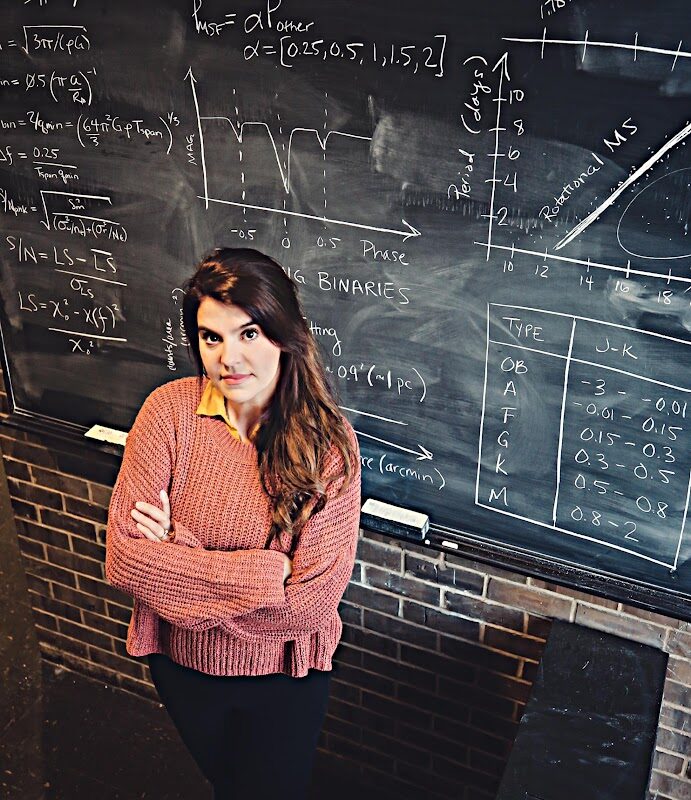
Melinda Soares-Furtado
PhD, Astrophysical Sciences
Assistant Professor, Departments of Astronomy & Physics, University of Wisconsin-Madison
Chamberlin 6275
1150 University Ave
Madison, WI
Melinda Soares-Furtado and Inspiring Students to Get Involved in Open Source Research
Melinda Soares-Furtado began her first open source project just months ago. An assistant professor of Physics and Astronomy, her experience coding open source projects was limited- but after hearing about the Open Source Program Office’s internship program, she decided it was the perfect opportunity to begin developing her dream project. Even with limited open source experience, Soares-Furtado has managed to create a functional product. She credits the project’s successful development to her collaborations with her OSPO student intern.
As an undergraduate, Soares-Furtado grew enamored with the stars beyond the Earth. As she connected with research opportunities, her passion only grew.
“There’s definitely been signs throughout my life that I was interested in science. For astrophysics in particular, my interest really came down to having a supportive research environment. I had the opportunity to experience research early on…that drew me in.”
One of Soares-Furtado’s current research interests has been age-dating stars. The process uses a variety of measurements to determine what chemical signatures surrounded a star when it was born. Age-dating as an area of research has become increasingly popular, especially as organizations like NASA look to find other liveable planets.
With increasing interest came the need for better tools. While current software for dating stars is reliable, Soares-Furtado believes recent technological developments can improve the process’ accuracy and speed.
“AI methods, neural nets in particular, began to kind of push the envelope in terms of the accuracy and the precision that we were after. Many scientists, including myself, began to wonder…can we train an algorithm to look at things like the stellar rotation and the activity of the star? Can we improve our predictions using this software?”
Although Soares-Furtado had years of experience age-dating stars, she knew she lacked the exact technical knowledge to properly execute the program she imagined. But when she heard from a coworker about the Open Source Program Office Internship Program, she knew she had to apply. It seemed almost too good to be true.
“At the time, I just thought, what the heck. I have an idea for a project, and it would be amazing to have a student help me build it. I didn’t have any formal training with tool development, so the idea that I could work with somebody with experience in it got me excited.”
Soares-Furtado’s research experience as an undergraduate allowed her to find her path. The OSPO program, she realized, could provide the same opportunity to a new generation. It was the final motivation she needed to begin exploring open source as a research medium.
Quickly, the intern established a prototype for the Machine Learning Gyrochronology Age Estimator, a machine learning tool that can determine the age of a star through a variety of data points. The intern communicates frequently with Soares-Furtado to understand her goals. The program is being developed using Python, an open source coding language.
“One thing I’m really appreciating is how quick we can move. We can take a dataset and explore multiple different correlations. It helps us get a sense of our predictor’s strengths.”
Although the Machine Learning Gyrochronology Age Estimator is Soares-Furtado’s first project, she believes the entire field of astrophysics has been moving towards open source. In science, it is important that data remains accessible and reproducible for anyone who wants to use it. The same is true of tools- the public should be able to access any necessary software.
Soares-Furtado is hoping that the expansion of open source will encourage more astronomers to become familiar with the technology.
“Early on in my career, I was warned to not focus too much on tools. People cared more about phenomenological discoveries. That is a stigma a lot of people in astronomy are trying to push against. A lot of impactful tools are currently being developed. That’s especially true right now with the emergence of AI tools. I think we’re going to see more and more astronomers embracing open source and the technology that comes with it.”
Soares-Furtado’s successful collaboration with the intern keeps the project moving forward. She hopes she can bring in even more collaborators as the project progresses.
“Being able to kind of build together and grow together in that environment’s important to me. There’s this lateral sort of connection that you have to a broader community… especially a community that is interested in your projects.”
When speaking of community, Soares-Furtado made sure to include the wider University of Wisconsin-Madison campus in her definition. UW professors have been open source pioneers, and continue to innovate in the field.
“I think Wisconsin in general is very positive [about open source] and very much…early adopters [of open source]. It’s a very open-source positive culture.”
The OSPO program, she hopes, will help connect more faculty to interested students. Research was an important part of her undergraduate experience, and she knows sharing that experience will help students find their paths.
“When I recruit students, I’m typically looking for graduate students or undergraduates in their first or second year. Finding students early gives us the time that we need to build a final result that they can own. I want to encourage these students and give them enough time to do deep research projects.”
There are UW Madison faculty who have been developing their open source projects for more than a decade. Soares-Furtado hopes that one day her project, and generally open source as a whole, will reach that same level of interest and sustainability. All open source needs is more marketing.
“There’s a real bimodality in terms of whether people have heard about it.”
Through the development of her project, Soares-Furtado has relearned the value of reaching out and looking for opportunities. Beginning an open source project is difficult. But getting involved in one, Soares-Furtado insists, is as simple as reaching out.
“Tools like GitHub and Zenodo are amazing. Anyone can use them, and they’re free to use. I think it would be great if students realized that they don’t have to wait until they are more experienced to begin contributing. In a lot of research, it’s great to start early on. Only by doing, will they deeply learn about complex topics.”